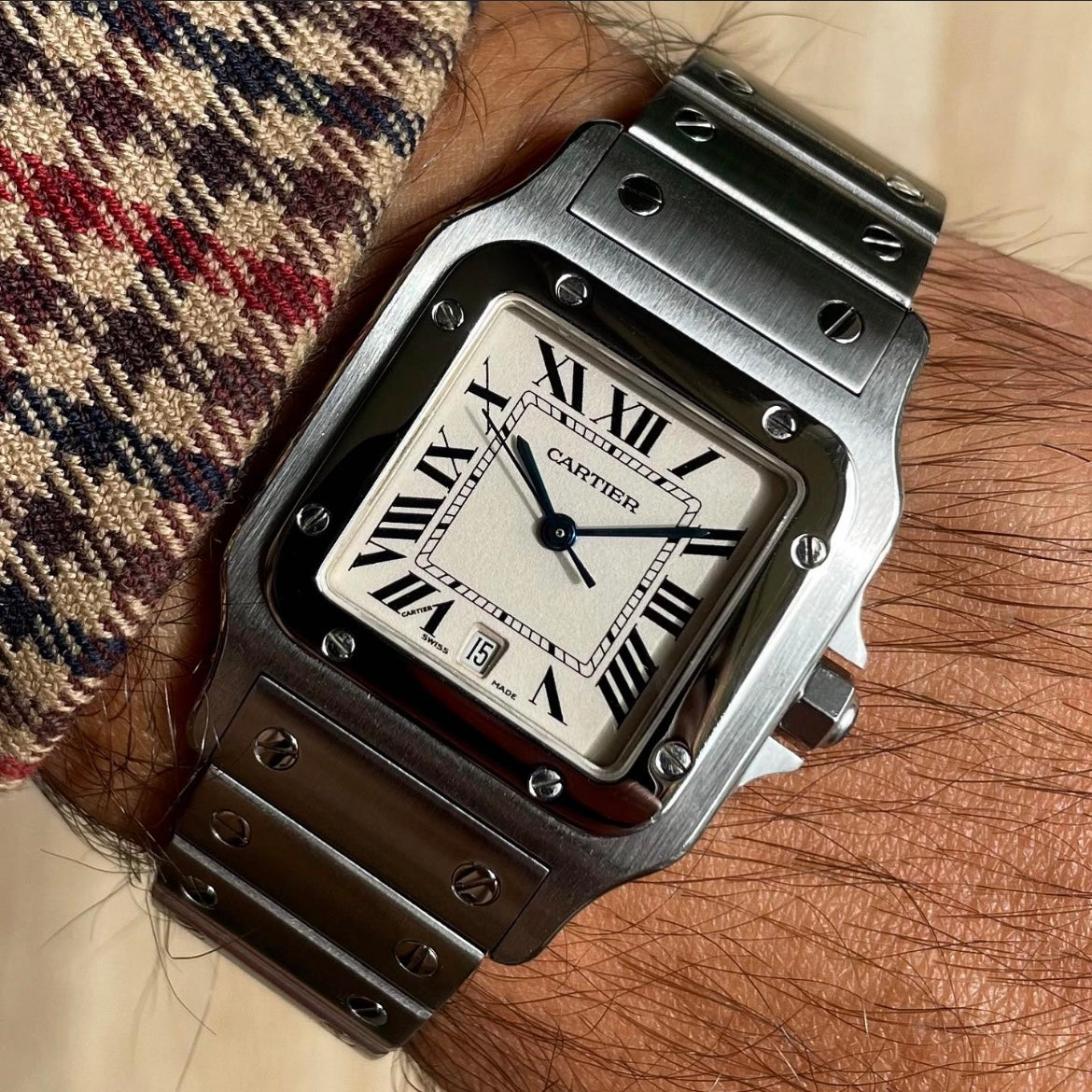
Visual Description
The Ref. 1564 is the Santos Galbée at its most elemental: stainless steel case and bracelet, white dial, Roman numerals, date at 6 o'clock. At 29 × 41 mm, the square case with curved sides sits close to the wrist, with the integrated bracelet flowing seamlessly from the case lugs. The polished bezel carries eight exposed screws — the Santos's visual signature since 1904 — and the octagonal crown is set with a synthetic spinel cabochon in Cartier's signature blue. The bracelet alternates polished center links with brushed outer links, creating a subtle play of light that prevents the all-steel construction from reading as flat.
Reference Significance
The 1564 is the Santos Galbée that most people wore, and for that reason it is the reference that defines the model. This was the entry point to Cartier ownership for a generation of buyers in the 1990s and 2000s — the first "real" Cartier many collectors ever put on their wrist. The quartz Cal. 87 was a deliberate choice: thin, accurate, and maintenance-free, it allowed the Galbée to be a genuine daily-wear watch without the service intervals that mechanical movements demand.
For the vintage market, the 1564 is experiencing the same reappraisal that the Omega Constellation and Rolex Air-King went through a decade ago. Once dismissed as too common and too quartz to be collectible, early-production examples are now being recognized for what they are: well-made watches with genuine design merit, produced during a specific era that is rapidly gaining collector legitimacy. Prices remain accessible — these are not yet expensive watches — which makes the 1564 one of the more interesting entry points in the vintage Cartier market.
The reference was also cataloged under the W-prefix system as W20060D6 during later production, though the earlier numeric 1564 designation is preferred among collectors for identifying vintage-era examples.
Historical Context
The Ref. 1564 was Cartier's answer to a specific market challenge of the 1990s: how to compete with quartz-powered luxury sports watches from brands like Omega (Constellation) and TAG Heuer (Formula 1) that were capturing the aspirational buyer segment. The answer was a watch that offered unmistakable Cartier design — the Santos case, the Roman numerals, the exposed screws — in a material and movement combination that kept the retail price below the psychological barriers of gold and mechanical.
The strategy worked. The stainless steel Santos Galbée became one of Cartier's highest-volume models, visible on wrists from Wall Street to the Champs-Élysées. Its 50-meter water resistance was meaningful for a daily-wear watch in an era when most Cartier dress watches were splash-proof at best.
What to Look For
The bracelet is the primary condition indicator. Check for stretched links (test for lateral play), missing or replaced screws (they should all be original with consistent slot alignment), and deployment clasp function. The clasp should open and close cleanly with a positive click — worn clasps that don't lock securely are a safety issue, not just a cosmetic one.
The bezel screws should be undamaged with no evidence of improper removal (burred slots, mismatched heads). The case back is a single piece secured by four screws — check that all are present and original. The octagonal crown's synthetic spinel cabochon should be intact; missing or chipped cabochons are common on high-use examples and reduce value. For the dial, verify the hidden Cartier signature within the VII Roman numeral and check that the date wheel is clean and properly aligned at 6 o'clock.