Visual Description
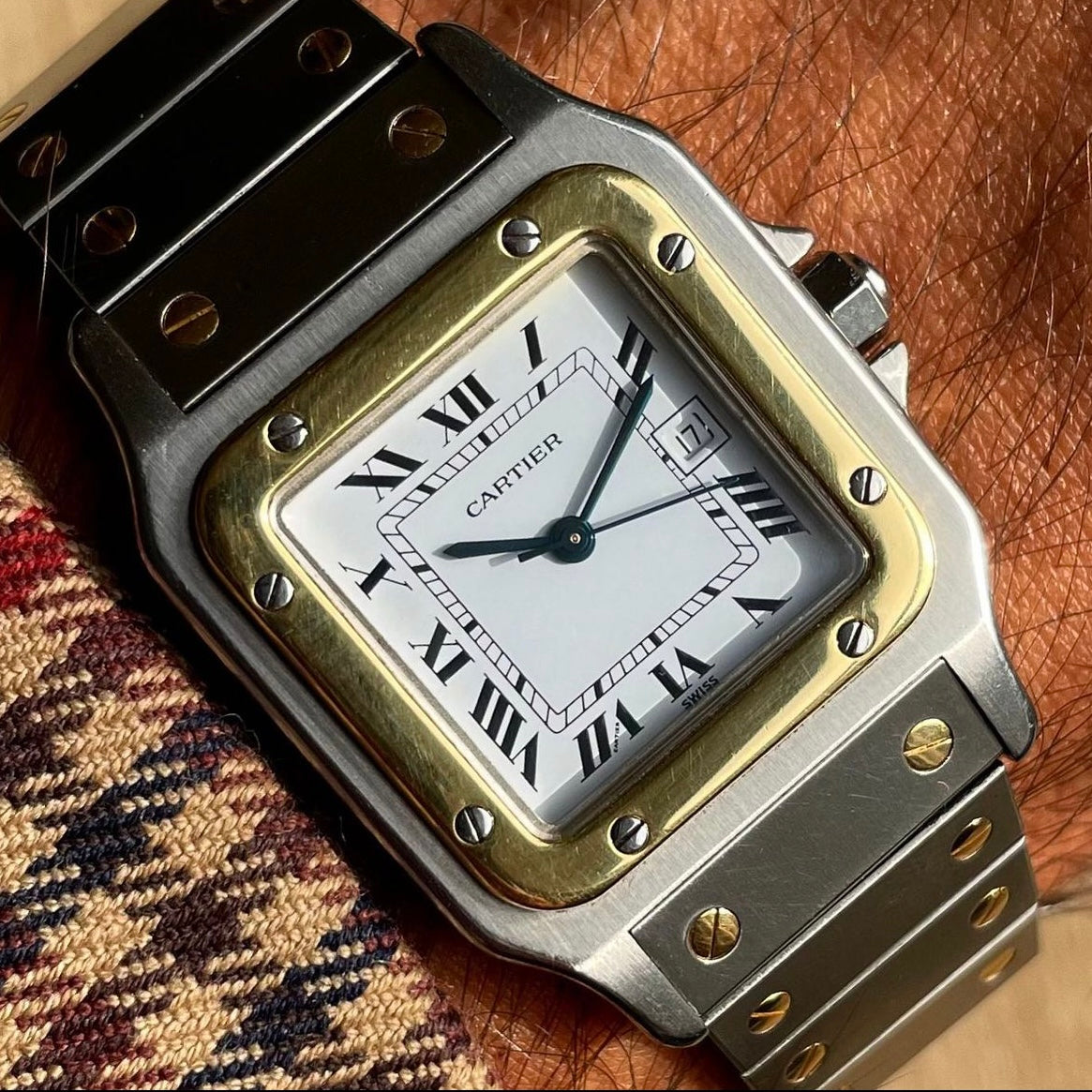
The Ref. 2961 presents the Santos Galbée in its most visually complete form: the two-tone combination of stainless steel and 18k yellow gold that many collectors consider the model's definitive expression. The polished gold bezel frames a white dial with black Roman numerals and a date aperture at 6 o'clock, while gold bracelet screws and crown accent the otherwise steel construction. The integrated bracelet carries the two-tone theme through alternating steel and gold links. The warm-cool contrast between the gold bezel and steel case band creates a visual richness that the all-steel 1564 cannot match, while avoiding the full commitment (and price) of solid gold.
Reference Significance
The Ref. 2961 occupies the collector sweet spot in the Santos Galbée lineup: it combines a mechanical automatic movement (the Cal. 077) with the two-tone material combination that gives the Galbée its most distinctive visual character. Where the quartz 1564 was the volume play, the 2961 was the watch for buyers who wanted mechanical credibility and the visual impact of gold without paying full-gold prices.
For the vintage market, the two-tone automatic Galbée represents the most collectible mainstream Santos Galbée configuration. The mechanical movement adds horological interest that quartz references lack, the gold elements add material value and visual warmth, and the overall package ages better than all-steel — the gold bezel develops a richer patina over time while the steel maintains its structure.
The 2961 also represents a specific moment in Cartier's production philosophy: the late 1980s and 1990s, when the maison was willing to put a proper automatic movement in a daily-wear steel-and-gold watch at an accessible price point. This democratization of mechanical Cartier — parallel to what the Tank Française W51002Q3 achieved in all-steel — helped establish a generation of mechanical watch wearers who might otherwise have defaulted to quartz.
Historical Context
The two-tone Santos Galbée entered production in the late 1980s, shortly after the Galbée line's 1987 launch. The choice to offer an automatic alongside the quartz was strategic: it positioned the Galbée as a serious horological offering, not just a fashion accessory with a Cartier name. The Cal. 077, based on the ETA 2671, was a proven automatic caliber that delivered reliable daily-wear performance — 38 hours of power reserve, hacking seconds, and a date complication.
Two-tone watches were a dominant aesthetic of the late 1980s and early 1990s, driven by broader fashion trends and by the commercial success of two-tone Rolex Datejusts and Omega Constellations. Cartier's two-tone Galbée was positioned to capture this demand with a design language that was distinctly Cartier — the exposed screws, the Roman dial, the square case — rather than a generic luxury sports watch.
What to Look For
The two-tone construction introduces specific authentication and condition points beyond those of the all-steel 1564. The gold bezel, bracelet screws, and crown should be solid 18k yellow gold — verify with hallmarks where visible. The gold tone should be consistent across all elements; any mismatch in color suggests a replacement part from a different production batch or aftermarket source.
Bracelet condition is critical. Two-tone bracelets are more complex than all-steel versions, and the gold links are softer than steel, making them more susceptible to scratching and stretching. Check for consistent link alignment, smooth articulation, and a deployment clasp that locks securely. Missing links — particularly gold links — are expensive to replace and significantly reduce value.
The case back should be steel with appropriate Cartier engraving and serial number. The Cal. 077 automatic movement should wind smoothly and maintain accurate time (within COSC-adjacent tolerances for a well-serviced ETA 2671 base). Listen for any unusual sounds when shaking the watch — rotor bearing issues are the most common mechanical concern on high-mileage automatic Galbées.