01DIAL
The Secret Signature
Introduced 1977
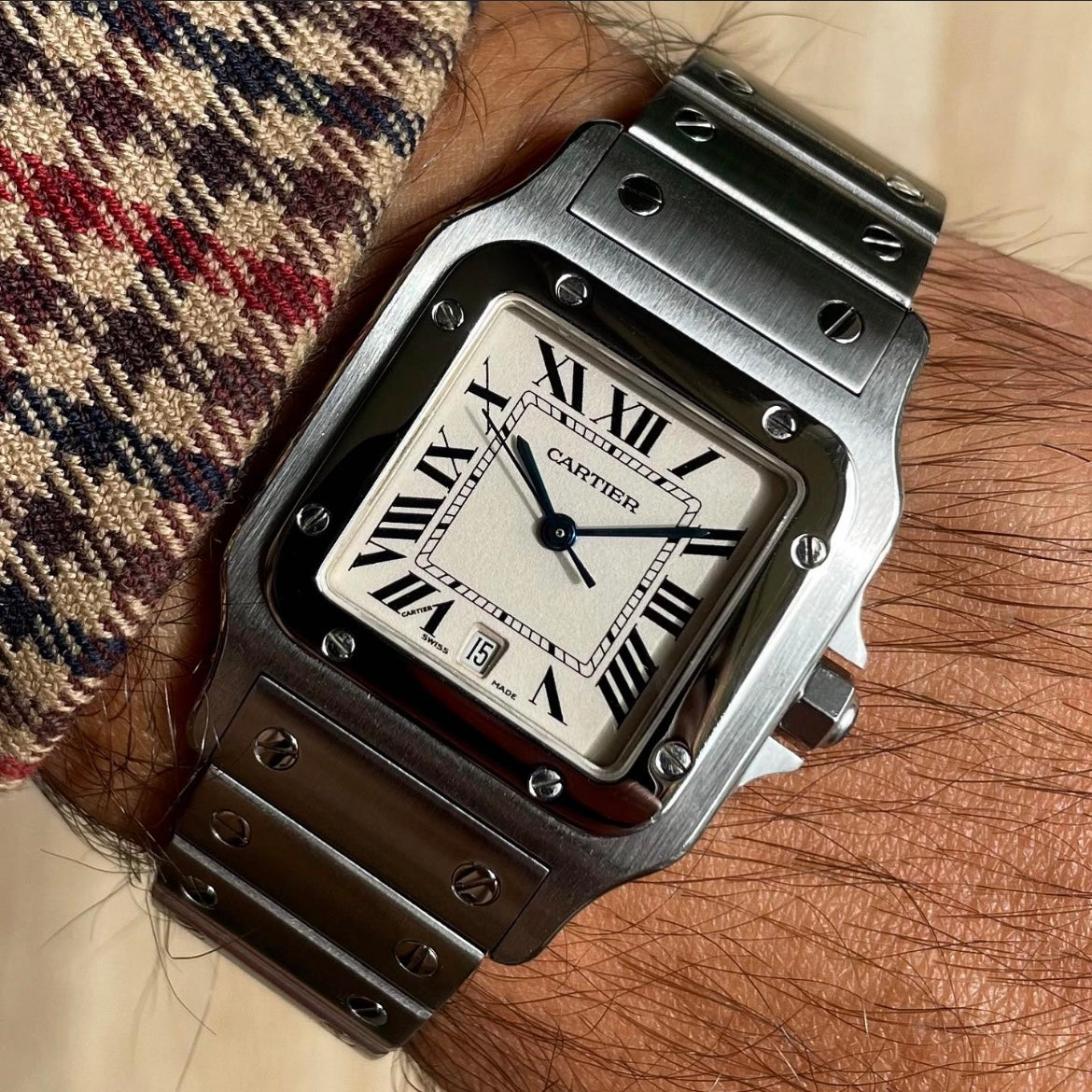
A microscopic 'CARTIER' hidden within the Roman numerals — present on every genuine post-1977 dial.
Cartier
The Santos redesigned for the wrist — curved, integrated, and built for daily wear.
The Santos Galbée arrived in 1987 as a fundamental rethinking of the Santos for contemporary wrists. Where the Santos Dumont maintained the flat, slim profile of the 1904 original, the Galbée — from the French "galbée," meaning "curved" — introduced a case that arced gently to follow the contour of the wrist. The integrated metal bracelet, with alternating polished and brushed links, was designed as an inseparable part of the watch rather than an aftermarket addition.
The design addressed a specific market reality: by the mid-1980s, the luxury sports watch category — defined by the Audemars Piguet Royal Oak, the Patek Philippe Nautilus, and the Vacheron Constantin 222 — had proven that collectors wanted integrated-bracelet watches they could wear every day. Cartier's response was to take its most iconic watch and rebuild it for that purpose, preserving the Santos's square case, exposed bezel screws, and Roman numeral dial while making everything else more robust, more ergonomic, and more suited to daily wear.
The Santos Galbée was among Cartier's most commercially successful watches of the 1990s. Available in stainless steel, two-tone (steel and 18k gold), and full gold configurations — and in both quartz and automatic movements — it covered a price spectrum broad enough to serve first-time Cartier buyers and established collectors alike. The stainless steel quartz Ref. 1564 was the volume leader: accessible, practical, and instantly recognizable.
This commercial success was also the Galbée's vulnerability to collector snobbery. For years, the model was dismissed as "the Cartier you buy at the airport" — a designation that said more about the collector community's biases than about the watch itself. The Galbée's design, engineering, and finishing were serious; its crime was being popular.
The market is correcting this. As neo-vintage collecting has expanded beyond the narrow canon of steel sport watches, the Santos Galbée has emerged as one of the most compelling value propositions in vintage Cartier. Early production examples from the late 1980s and 1990s — particularly two-tone automatic references — are attracting collector attention that would have been unthinkable five years ago.
The Santos Galbée was produced in three primary case sizes across its vintage-eligible run: the large model (LM) at 29 × 41 mm, a midsize, and a small model (SM) for ladies. The large model is the primary collector focus. Movement options included quartz calibers (Cal. 87 and Cal. 157 across production years) and an automatic (Cal. 077, based on the ETA 2671).
Material configurations ranged from full stainless steel through two-tone to full 18k gold, with the two-tone variants — featuring gold bezel, bracelet screws, and crown on a steel case and bracelet — occupying the aesthetic sweet spot for many collectors. Water resistance was rated to 50 meters, making the Galbée one of the more practical vintage Cartier options.
Production continued through 2005, with references produced through 2001 falling within Archiva's vintage scope. The model was discontinued and eventually succeeded by the Santos de Cartier in 2018.
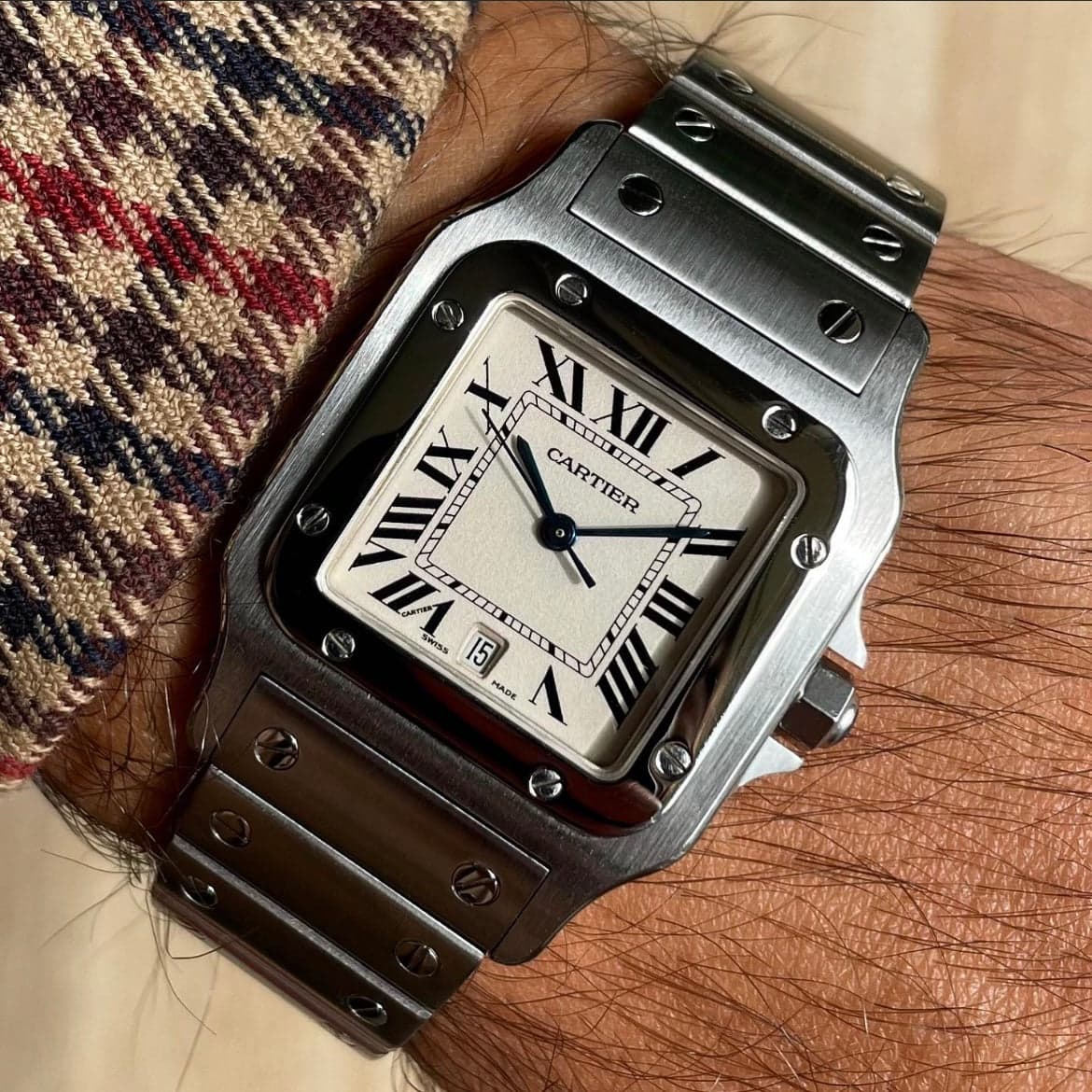
Ref. 1564 · c. 1990s–2000s
The stainless steel quartz Ref. 1564 Santos Galbée — the volume reference that democratized the Santos for a generation and proved Cartier's redesigned bracelet-integrated sports watch concept worked at scale. At 29 × 41 mm with polished and brushed links, quartz reliability, and robust construction, it established the Galbée's commercial identity and remains the most accessible entry point to the Santos family. While initially dismissed as 'the airport Cartier,' examples from the 1990s production years are now attracting serious collector attention.
5 documented references across 2 eras
| Reference | |
|---|---|
| Ref. 187901 | |
 | Ref. 2961 |
| Ref. 987901 |
| Reference | |
|---|---|
 | Ref. 1564 |
| Ref. 1565 |
What every buyer, inheritor, and first-time collector should know.
Coming soon — vetted dealer listings for Santos Galbée.
Introduced 1977
A microscopic 'CARTIER' hidden within the Roman numerals — present on every genuine post-1977 dial.
Varies by era
Genuine Cartier cases bear specific hallmarks including the Cartier name, reference number, serial number, and precious metal assay marks. Placement and style varies by era, with earlier pieces showing different hallmark configurations than modern examples.
Varies by era and model
Cartier sourced movements from various Swiss manufacturers throughout history, including Jaeger-LeCoultre, Frédéric Piguet, ETA, and in-house production. Knowing the correct caliber for a specific reference is essential for authentication and establishing provenance.
A Cartier hallmark since the early 20th century
The blue sapphire (or spinel on less precious models) cabochon crown is a Cartier signature. Original crowns show consistent color saturation and are set flush with the crown body. Replacements often show misalignment or incorrect stone dimensions that reveal themselves under magnification.
Check the clasp first
Cartier bracelets carry their own reference markings and the deployment clasp should bear the Cartier name and logo. Aftermarket bracelets are extremely common on vintage pieces, so verifying clasp authenticity and matching reference numbers is crucial to overall authentication.
Patina tells the story
Vintage Cartier dials develop characteristic aging—cream dials warm to ivory, lacquer dials may develop fine crazing, and applied indices can show legible wear patterns. Understanding acceptable versus concerning dial aging is key to valuing a vintage piece authentically.
Coming soon — price trends and comparable sales for Santos Galbée.
Identify your Santos Galbée reference, understand its position in the model's lineage, and assess its current market value.
START HERE →BUYERKnow which references are vintage-eligible, what distinguishes authentic examples, and what to pay.
CHECK BEFORE YOU BUY →SELLERPrice your Santos Galbée with current comparables, condition assessment, and variant-specific value drivers.
PRICE MY WATCH →