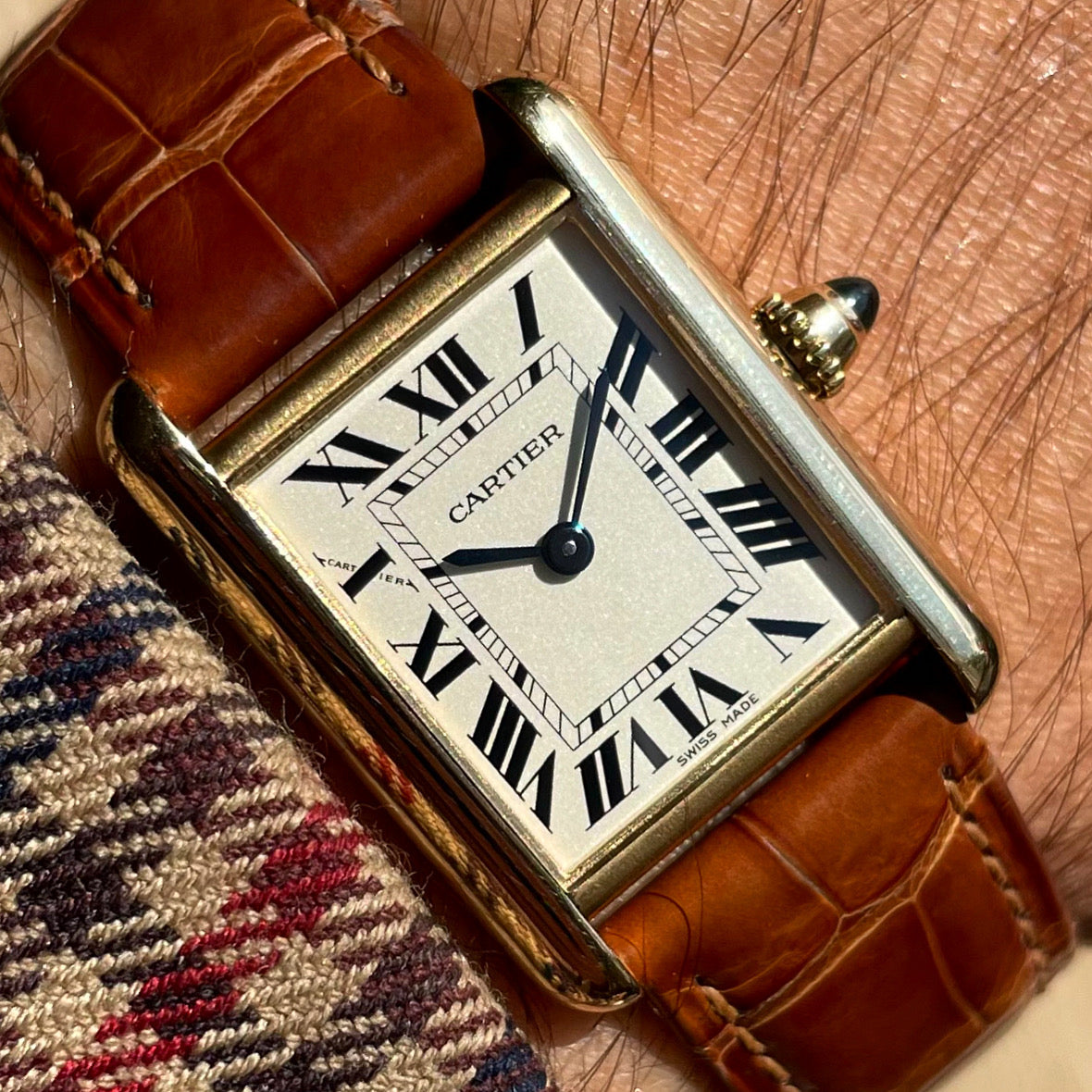
Visual Description
The 2442 embodies restrained elegance through understatement. At 22 × 30 mm in solid 18k yellow gold, it occupies the diminutive end of the Tank Louis spectrum—a proportional echo of the Tank Must's accessibility, but in material terms, an unambiguous luxury object. The case catches light with the characteristic warmth of yellow gold of the 1990s, which typically reads more orange-toned than modern alloys tuned for neutral warmth. The silvered dial provides exceptional contrast, its painted black Roman numerals and railroad minute track executing the Tank Louis visual grammar with austere precision. The hidden Cartier signature at 10 o'clock—visible only when the watch is held to backlighting—exemplifies the brand's commitment to understated authentication; those who know recognize; those who don't need not be told.
The blued steel sword hands move across the dial with the quartz's characteristic certainty: precision without grace, functionality without mechanical ritual. The sapphire crystal, standard equipment on all Tank Louis examples, sits flush with the case edge. The black alligator strap, a Cartier stock item for decades, wraps around the wrist with a slight formality that announces without shouting. The 18k yellow gold deployant clasp—stamped with Cartier signatures and engineering marks—closes with the definitive click that characterizes fine watchmaking, regardless of whether the movement inside ticks with mechanical passion or electronic precision.
Reference Significance
The 2442 quartz Tank Louis occupies an unusual historical position: it is simultaneously common and undervalued. Cartier produced these examples in significant quantities throughout the 1990s and early 2000s, and they appear regularly in European vintage watch markets, often at prices ($800–$1,500) that barely reflect their 18k gold weight and maker provenance. For collectors, the significance lies in recognizing this undervaluation as an opportunity rather than a shortcoming.
The quartz movement is not a compromise in the Tank Louis context; it is a design choice that prioritizes the visual and tactile experience of the watch—the geometry, the metal, the bracelet engineering—over the mechanical performance underneath. The Cal. 057, a robust Swiss quartz movement, requires no servicing beyond occasional battery replacement and offers accuracy that few collectors actually achieve with mechanical watches through regular wear and neglect. The 2442, in this sense, offers the Tank Louis aesthetic with the practical benefits of accuracy, thinness, and near-zero maintenance—a combination that younger collectors and women's watch enthusiasts have only recently begun to rediscover.
Historical Context
The Tank Louis was reintroduced in 1989 as Cartier's revisioning of the original Tank design for a contemporary market. The early 1990s offered a strategic moment: the quartz revolution had matured, sapphire crystals had become industry standard, and the quartz movement had shed its earlier stigma as a luxury substitute. The 2442, positioned as the yellow gold quartz variant of the Tank Louis line, offered Cartier the opportunity to produce a watch that was mechanically identical to its mechanical siblings (the 2441, equipped with the Cal. 120 manual-wind movement) but differentiated by material and movement specification.
The late 1990s and early 2000s saw the peak of the Tank Louis's market presence before the Cartier brand began consolidating its sports watch offerings around stainless steel and integrated bracelets. The quartz 2442, produced during this window, benefited from mature case manufacturing and finishing techniques while avoiding the rising production costs that would later drive Cartier toward quartz-only offerings in precious metals. As a result, these examples offer a snapshot of the moment before the modern Cartier aesthetic—the moment of maximum technical refinement in the analog luxury watch world.
What to Look For
Verify the case hallmarks: authentic 18k yellow gold examples should display the Cartier maker's mark, the 750 standard mark (18k), and country of manufacture mark (typically Geneva). Examine the case for signs of replating, which manifests as overly uniform color and an absence of patina on the high points; original gold develops subtle color variation over decades. The deployant clasp, a likely replacement point on watches of this age, should match the case material and bear appropriate hallmarks if replaced; verify that it functions smoothly without excessive play.
The dial, when original, will display a slight aging patina—a very subtle yellowing or dulling of the silvered surface—rather than the sharp brightness of a relumed dial. The painted numerals should be intact with no flaking or repainting evidence. Examine the 10 o'clock signature under backlighting; a faint signature indicates originality, while an absent signature suggests dial replacement. The caseback, which should be solid gold and display the reference number, production mark, and Cartier signature, should show no signs of amateur polishing or re-engraving. Finally, test the sapphire crystal: it should be scratch-resistant but not absolutely immune; a few light scratches are period-correct, but deep scratching or milking (internal stress fractures visible under backlighting) indicates impact damage or defective manufacturing.