01DIAL
The Secret Signature
Introduced 1977
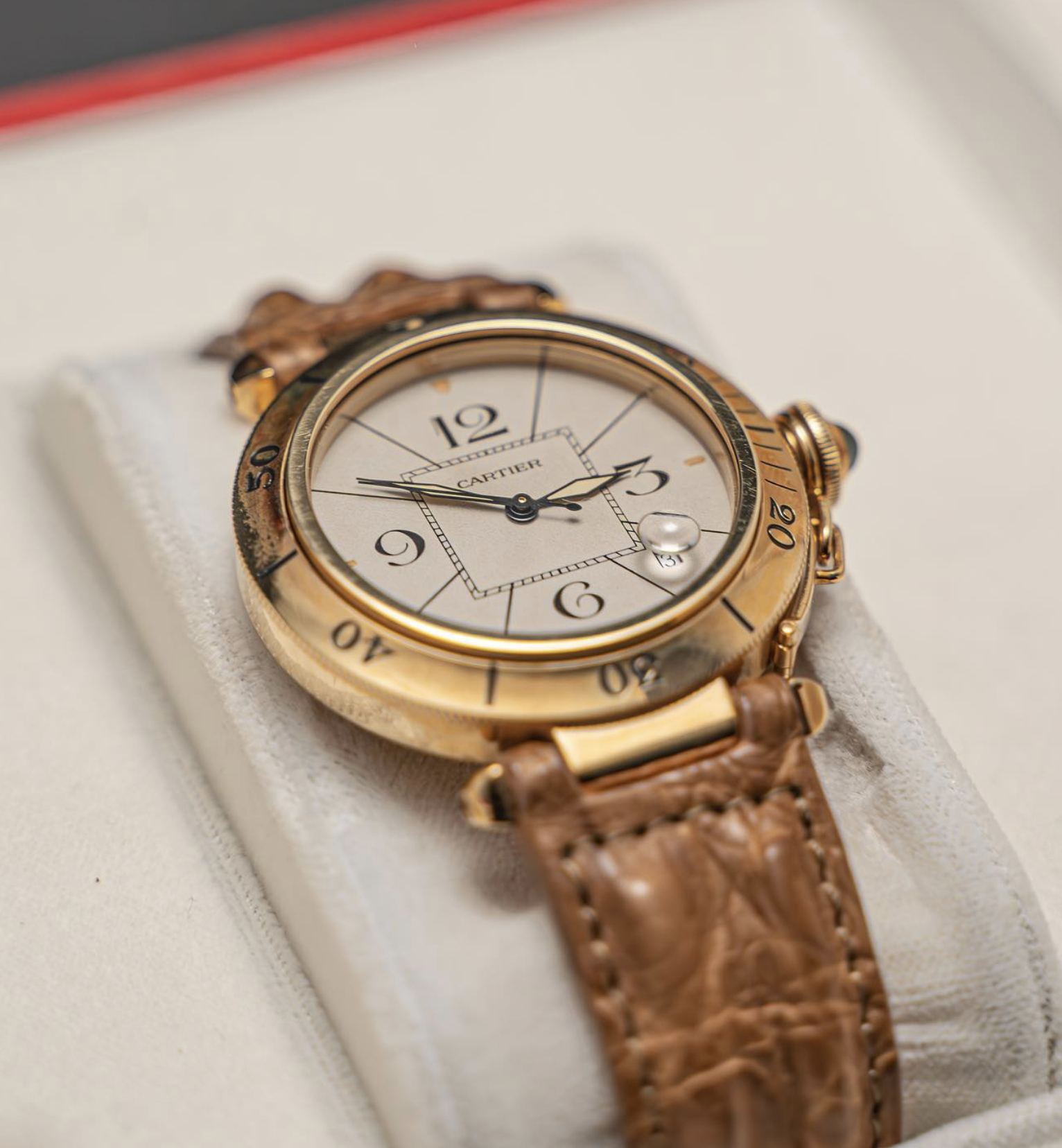
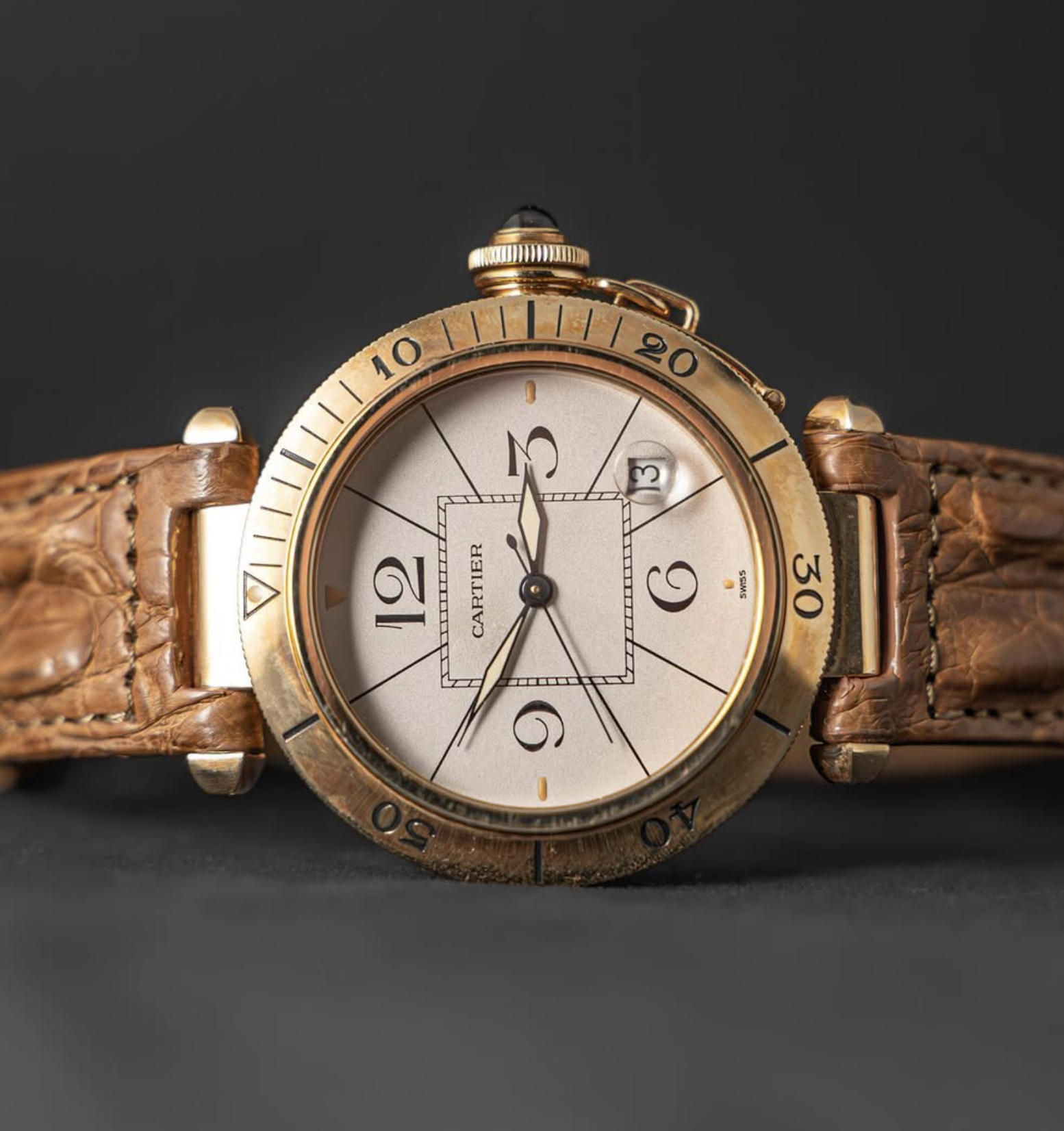
A microscopic 'CARTIER' hidden within the Roman numerals — present on every genuine post-1977 dial.
Cartier
Gérald Genta's bold round sports watch for Cartier — the 38mm design that broke the maison's rectangular tradition and introduced steel to a new generation of collectors.
When Gérald Genta designed the Pasha de Cartier in 1985, he was solving a problem that Cartier didn't know it had. The maison's identity was built on shaped cases — the Tank, the Santos, the Tortue, the Tonneau — geometric forms that defined a century of Cartier watchmaking. A round sports watch was not just different; it was a deliberate break from everything Cartier represented.
The Pasha's origin story traces to a 1932 commission: El Glaoui, the Pasha of Marrakech, reportedly asked Cartier for a watch he could wear while swimming. That bespoke piece was a one-off. The modern Pasha collection, introduced fifty-three years later, borrowed the name and the waterproof intent but was an entirely new design by Genta — the same designer responsible for the Audemars Piguet Royal Oak and Patek Philippe Nautilus.
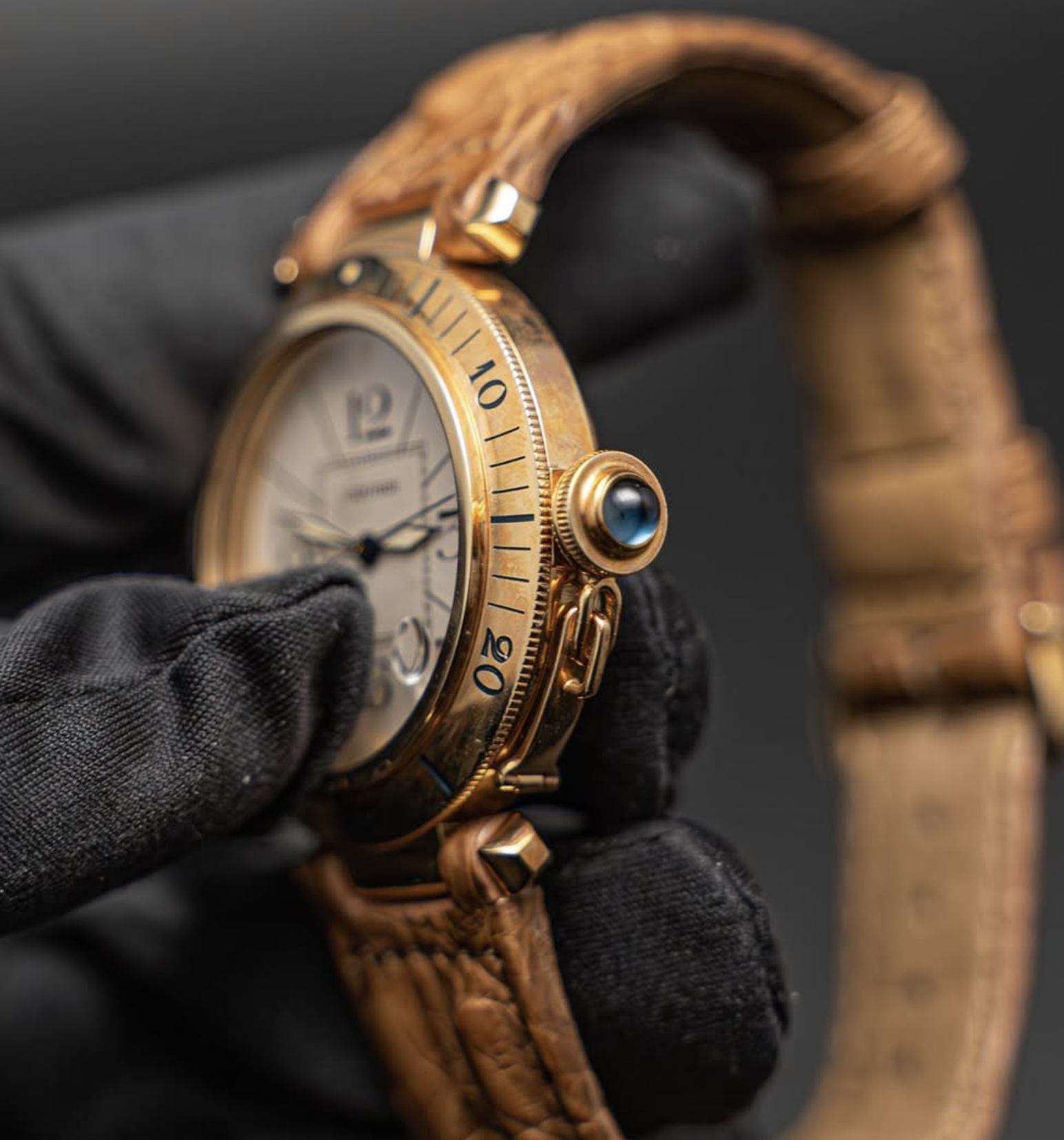
Genta's Pasha was deliberately muscular for Cartier: a 38mm round case — large by mid-1980s standards — with a screw-down crown cap connected to the case by a short security chain, a rotating calibrated bezel, and a distinctive square minute track set within the circular dial. The crown cap, topped with a cabochon sapphire, served a functional purpose (waterproofing) but became the model's most recognizable design signature. Eight screws secured a sapphire exhibition caseback, giving the Pasha a mechanical presence that Cartier's dress watches never aspired to.
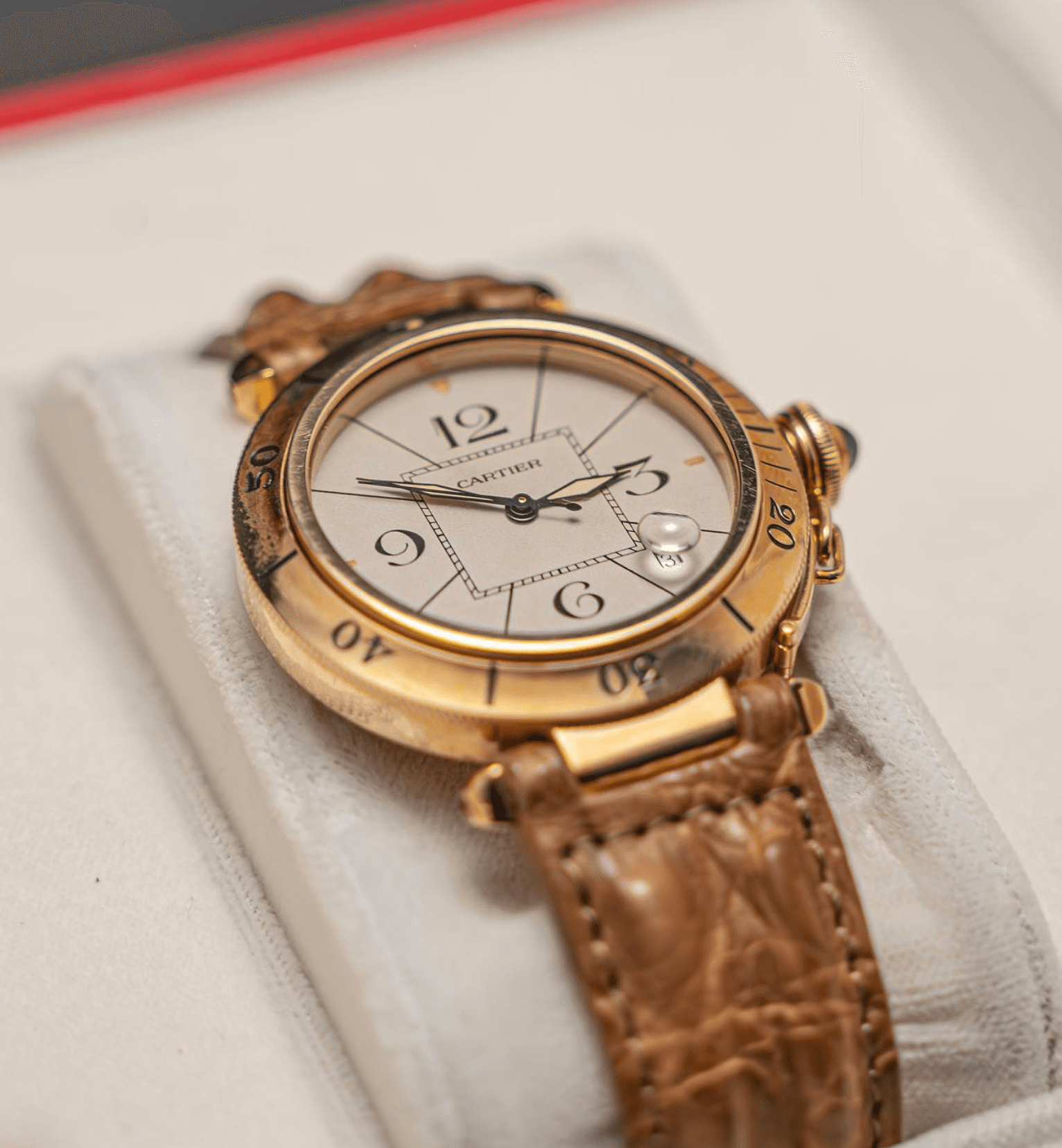
The first Pasha references — the 820901 and 820903 — were produced exclusively in 18k yellow gold. These early pieces are identifiable by the absence of a cyclops date lens and by their graduated bezel markings. Production was limited; the gold-only positioning reflected Cartier's uncertainty about how the market would receive a round sports watch from a maison synonymous with shaped cases.
In 1990, Cartier introduced the Pasha in stainless steel with the Ref. 2378, and the model's trajectory changed immediately. Steel brought the Pasha's price below the gold-only threshold, opening it to a much broader collector base. The Cal. 191 movement — a 27-jewel automatic — provided reliable daily-wear performance. The steel Pasha proved that the design worked as a sports watch, not just a precious-metal statement.
Through the 1990s, the Pasha expanded into multiple complications and variants. The Ref. 2379 introduced the Grille — a removable protective grid over the dial that gave the watch a distinctive porthole aesthetic and enhanced its sporty identity. Chronograph references, GMT variants, and even tourbillons followed. The Pasha C sub-line (from 1995) offered a more compact 35mm case for buyers who found the standard 38mm too assertive.
The vintage Pasha market is shaped by two distinct tiers. First-series gold references (820901, 820903) from 1985–1989 command significant premiums as the original expression of Genta's design — they are rare, historically important, and unmistakably different from later production. The 1990s steel references (2378, 2379) offer the core Pasha experience at more accessible prices, with the Grille variant attracting particular collector interest for its visual distinctiveness.
For collectors entering the vintage Cartier market, the steel Pasha represents something unusual: a Gérald Genta design that remains undervalued relative to his work for Audemars Piguet and Patek Philippe. The Royal Oak and Nautilus have been repriced by the market into six-figure territory; the Pasha, with equally strong design DNA, trades at a fraction of those levels. Whether that gap closes is an open question — but the design pedigree is not in dispute.
Ref. 820903 · c. 1985–1989
The Pasha Ref. 2378 in stainless steel — the model that democratized Genta's 1985 design by bringing it from exclusive gold production into steel. With its 38mm round case, signature screw-down crown cap on a security chain, rotating bezel, and sapphire exhibition caseback, the 2378 represents the Pasha at its most accessible and its most culturally significant. The steel Pasha proved that Cartier could compete in the luxury sports watch category on pure design merit.
3 documented references across 1 era
| Reference | |
|---|---|
| Ref. 2378 | |
| Ref. 2379 | |
 | Ref. 820903 |
What every buyer, inheritor, and first-time collector should know.
Coming soon — vetted dealer listings for Pasha de Cartier.
Introduced 1977
A microscopic 'CARTIER' hidden within the Roman numerals — present on every genuine post-1977 dial.
Varies by era
Genuine Cartier cases bear specific hallmarks including the Cartier name, reference number, serial number, and precious metal assay marks. Placement and style varies by era, with earlier pieces showing different hallmark configurations than modern examples.
Varies by era and model
Cartier sourced movements from various Swiss manufacturers throughout history, including Jaeger-LeCoultre, Frédéric Piguet, ETA, and in-house production. Knowing the correct caliber for a specific reference is essential for authentication and establishing provenance.
A Cartier hallmark since the early 20th century
The blue sapphire (or spinel on less precious models) cabochon crown is a Cartier signature. Original crowns show consistent color saturation and are set flush with the crown body. Replacements often show misalignment or incorrect stone dimensions that reveal themselves under magnification.
Check the clasp first
Cartier bracelets carry their own reference markings and the deployment clasp should bear the Cartier name and logo. Aftermarket bracelets are extremely common on vintage pieces, so verifying clasp authenticity and matching reference numbers is crucial to overall authentication.
Patina tells the story
Vintage Cartier dials develop characteristic aging—cream dials warm to ivory, lacquer dials may develop fine crazing, and applied indices can show legible wear patterns. Understanding acceptable versus concerning dial aging is key to valuing a vintage piece authentically.
Coming soon — price trends and comparable sales for Pasha de Cartier.
Identify which Pasha reference you have — gold or steel, grille or open dial — and understand where it sits in the model's production history.
START HERE →BUYERKnow the difference between first-series gold, steel automatics, and grille variants — and what to verify before purchasing.
CHECK BEFORE YOU BUY →SELLERPasha values vary significantly by era, material, and condition. First-series gold commands multiples of later steel production.
PRICE MY WATCH →